

The deal closes on a Friday. By Monday, new ownership wants a management report. Someone hands over books that have never actually been verified — just inherited. Nobody plans to build the future on unreconciled numbers. It happens anyway. Closing the deal and closing the books are two different jobs, and only one of them gets a party. I’ve been the one opening those books more times than I can count. The surprises are rarely where anyone expected to look.
Why the Opening Balance Sheet Is the Foundation, Not a Formality
The opening balance sheet is the snapshot of the business at the exact moment ownership changes hands. Every purchase price adjustment gets measured against it. Every working capital true-up gets measured against it. Every management report for years afterward gets built on top of it. Whether anyone re-checks the starting point or not.
Get the opening balance sheet wrong, and the error doesn’t stay in the past. It compounds forward into every close that follows. In my experience, the businesses that skip this step aren’t being careless. They’re just moving fast. After months of deal work, the opening balance sheet is easy to treat as a formality instead of the foundation it actually is.
Where Legacy Books Usually Break
Most sellers’ books were built to run their business, not to survive a buyer’s scrutiny. A few patterns show up again and again:
- Intercompany balances netted to zero, not reconciled. They were made to disappear on the surface rather than actually tied out.
- A bulk-imported chart of accounts. Nobody mapped it line by line, so old miscoding just moves into the new system.
- Accruals that never existed in the first place. Warranty reserves, accrued PTO, sales tax exposure in states nobody registered in.
- Inventory or WIP carried over at face value. The valuation came from a legacy costing system, and nobody tested whether the underlying costs were ever right.
- AR and AP aging that looks clean because it was never reconciled to the sub-ledger. Clean and accurate aren’t the same thing.
The Step-Up: Why Fair Value Isn’t Just a Valuation Exercise
Under US GAAP purchase accounting (ASC 805), the acquired company’s assets and liabilities get restated to fair value as of the close date. They aren’t carried over at the seller’s old book value. Inventory, fixed assets, intangibles — all of it gets revalued. The difference between the old carrying value and the new fair value is the step-up.
That step-up creates a second problem most people don’t see coming: a mismatch between the new book basis and the existing tax basis. In a stock deal, the tax basis of the underlying assets usually doesn’t move even though the book basis just did. That gap has to be recorded as a deferred tax asset or liability on the opening balance sheet. Getting the sign and the amount right depends on deal structure. A straight stock purchase behaves differently than an asset deal. It behaves differently again from a stock deal with a Section 338(h)(10) election, where the tax basis steps up too.
I’ve watched this get treated as a footnote until the auditors ask for the deferred tax rollforward. By then, the valuation report that should have driven the entry is three months old, and nobody remembers which draft was final. ASC 805 allows a measurement period of up to one year to true up provisional amounts. That’s generous — but only if someone is actually tracking what’s still provisional.
PPA: Identifying and Valuing the Intangibles
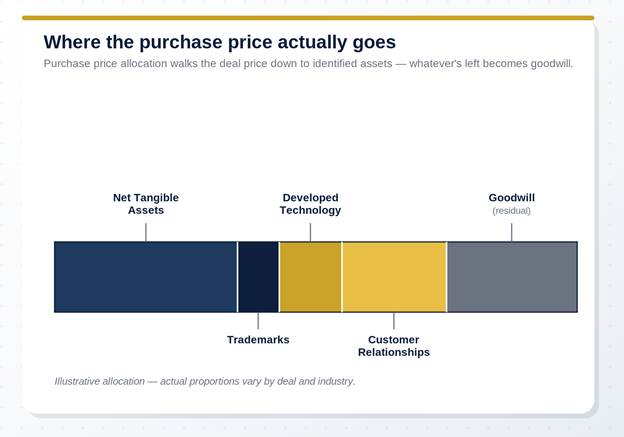
Purchase price allocation is where the step-up gets specific. A valuation specialist identifies and prices each intangible asset separately. Trade names and trademarks usually get a relief-from-royalty calculation. Developed technology or patents get relief-from-royalty or an excess-earnings approach, depending on how the asset actually generates value. Customer relationships or contracts typically get a multi-period excess earnings method, one that leans heavily on an assumed customer attrition rate.
One thing worth clearing up: an assembled workforce doesn’t get recognized as its own intangible asset under US GAAP. It’s a real driver of value. It often gets modeled during the valuation work as a contributory asset charge, but it lands inside goodwill rather than as its own line item. More than one client has walked in expecting a workforce intangible to show up on the balance sheet. It never does.
Whatever’s left after every identifiable intangible and tangible asset gets its fair value is goodwill. Each identified intangible then gets its own useful life and amortization schedule. That means the PPA doesn’t just set the opening balance sheet. It sets a piece of the P&L for years afterward — amortization expense that shows up every month, and gets added back in every EBITDA reconciliation from that point on.
Leases Don’t Carry Over — ASC 842 at the Acquisition Date
Leases are their own trap. Under the ASC 842 business combination guidance, the right-of-use asset and lease liability don’t simply transfer from the seller’s books. They get remeasured as of the acquisition date. That means using the remaining lease term and a discount rate current as of close, not whatever rate the seller happened to use when the lease originally started.
That remeasurement is straightforward when the seller’s lease accounting was solid. It gets complicated fast when it wasn’t. I’ve walked into more than one post-close review where the ASC 842 implementation had real gaps. An equipment lease booked as a plain operating expense instead of a right-of-use asset. An embedded lease buried inside a service or supply agreement that nobody flagged. A renewal option that should have been included in the lease term and wasn’t. None of that surfaces from a glance at the balance sheet. It surfaces from pulling every lease and service agreement and checking it against the standard directly. That’s tedious, and it’s exactly the kind of thing that gets skipped when everyone is focused on getting the deal closed.
The Review That Actually Catches It
None of this shows up from a glance at the trial balance. It shows up from a specific process, account by account:
- A full trial balance walkthrough as of the close date. Not “recent” numbers that drift a few weeks either direction.
- A detailed reconciliation for every material balance. Tie the sub-ledger to the general ledger line by line, not just the totals.
- A real chart-of-accounts mapping. Built by someone who understands both entities’ books, not a bulk import that assumes the labels already line up.
- An aging analysis on AR, AP, and inventory specifically as of the close date. That’s the number every future adjustment gets measured against.
- A dedicated review of the step-up, PPA, and lease remeasurement. These entries come from outside the day-to-day accounting team — a valuation specialist, a tax advisor, a lease abstraction. They need to be checked into the books deliberately, not assumed correct because a report exists.
Making It Stick
Finding the problems is half the job. The other half is making sure they don’t come back next quarter.
That means resetting the close calendar around the new entity’s actual reporting needs, not whatever cadence the seller happened to use. It means assigning a specific owner to each account, so reconciliation isn’t a scramble at month-end. And for the first two or three closes after the acquisition, it means reviewing results against the opening balance sheet specifically, not just against last month. Any remaining error surfaces while it’s still cheap to fix.
A Foundation Worth Checking
A clean opening balance sheet isn’t glamorous work. It rarely gets mentioned in the deal announcement. But it’s the thing every number after it depends on. Businesses that skip it tend to find out the hard way — usually around the first audit, the first covenant test, or the first time a number doesn’t reconcile and nobody can say why.
If a recent acquisition still has you working off books you inherited rather than books you’ve verified, that gap is worth closing before it compounds any further. I’ve never had a client regret doing it properly. I’ve seen plenty regret skipping it.
Robert Idzi, CMA, CSCA