
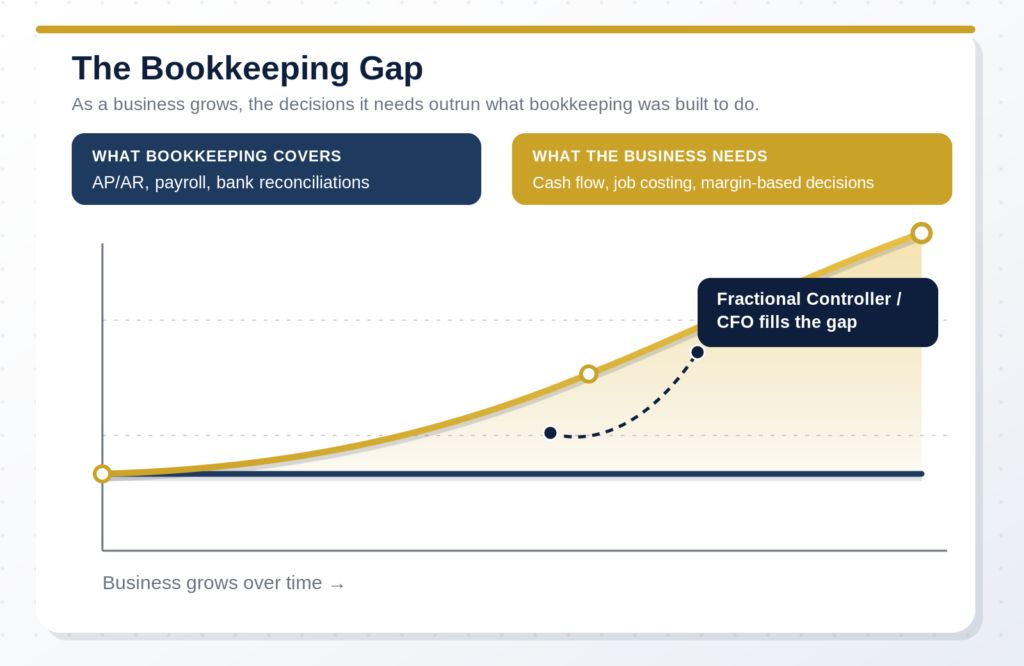
Your bookkeeper closes the books by the 10th every month. Invoices go out on time, payroll never misses a beat, and the bank reconciles clean. And yet you’re staring at a P&L that says you made money last quarter without any real sense of whether you can afford the new CNC machine, add a second shift, or extend 60-day terms to the customer who just asked for them. That gap isn’t a bookkeeping problem — it’s a sign you’ve outgrown your bookkeeper, and haven’t yet built what should replace them.
What a Good Bookkeeper Actually Does — and Where the Job Stops
A strong bookkeeper is worth their weight in gold: accounts payable and receivable stay current, payroll runs correctly, the bank and credit card accounts reconcile, and the financial statements tie out. That’s the system of record, and it has to be right before anything else can happen.
But recording history accurately is a different job from interpreting it. Bookkeeping isn’t designed to forecast cash 13 weeks out, build the cost model behind a quote, or tell you which of your product lines actually make money once real overhead absorption is factored in. That’s not a knock on the role — it was never meant to do that.
Five Signs You’ve Outgrown Your Bookkeeper
- You’re profitable on paper but can’t explain why cash felt tight this month. The P&L and the bank balance are telling different stories, and nobody’s translating between them.
- Every big decision starts with “let me check with accounting” and ends with a guess. New equipment, a new hire, new customer terms — the numbers exist, but nobody’s turning them into a recommendation.
- Your reports show what happened, not what to do next. You get a clean income statement and balance sheet, but no read on trend, risk, or what needs attention this month.
- You’ve started building your own spreadsheets outside the books. If you’re re-deriving margin by customer or product because the reports don’t answer the question, that’s the gap making itself known.
- Job costs and true margins feel more like folklore than numbers you’d bet on. Everyone has a sense of which jobs are “good ones,” but nobody can point to the analysis behind it.
Why the Next Step Isn’t (Necessarily) a Full-Time CFO
The instinct, once these signs pile up, is to think the answer is a full-time CFO hire. For most businesses in the $5M–$50M range, that’s overkill — a six-figure salary and benefits package for what usually amounts to 10–15 hours a month of senior-level financial thinking, not a daily executive presence.
What’s actually missing isn’t headcount. It’s a layer of financial interpretation and controller-level rigor that sits between the bookkeeping function and the decisions the owner is already making. That layer can be built without a full-time hire — which is exactly the gap a fractional controller or CFO engagement is designed to fill.
What Fills the Gap
In practice, this looks like a 13-week cash flow model that gets updated and actually used, job costing that ties real material, labor, and overhead back to the quote, a monthly package that includes commentary and a recommendation instead of just statements, and a seat at the table — part-time, not daily — when the equipment purchase or the new customer terms are actually being decided.
A Quick Gut Check
If you’re not sure which side of the gap you’re on, three questions usually settle it: Could you produce a 13-week cash forecast today if a lender asked for one tomorrow? Do you know which of your top five customers is actually the most profitable, after true overhead? When you last made a six-figure decision, did the numbers drive it, or confirm a decision you’d already made?
If any of those land uncomfortably, the gap between bookkeeping and full-time CFO isn’t hypothetical — it’s already costing you decisions.
The move from bookkeeping to real financial leadership rarely announces itself with a single event. More often it’s a string of small moments like the ones above, adding up until the gap is too expensive to keep ignoring. If any of this sounds familiar, it might be worth a conversation about what the next 90 days would look like with someone translating the numbers into decisions.
Robert Idzi, CMA, CSCA