
It’s one of the more disorienting moments for a business owner: the financial statements say the company had a strong month. Revenue is up, the P&L shows solid margin, and by every accounting measure, things are going well. And yet the bank balance is tight — payroll is a stretch, a vendor is calling about a past-due invoice, and it’s not obvious why, because the numbers say you’re profitable.
You’re not imagining it, and it’s not bad management. It’s the natural result of two financial statements that are answering two different questions. The P&L asks, “did this transaction create value?” The bank account asks, “do I have the money right now?” Most of the time those two answers arrive on different days — sometimes weeks or months apart.
A simple example
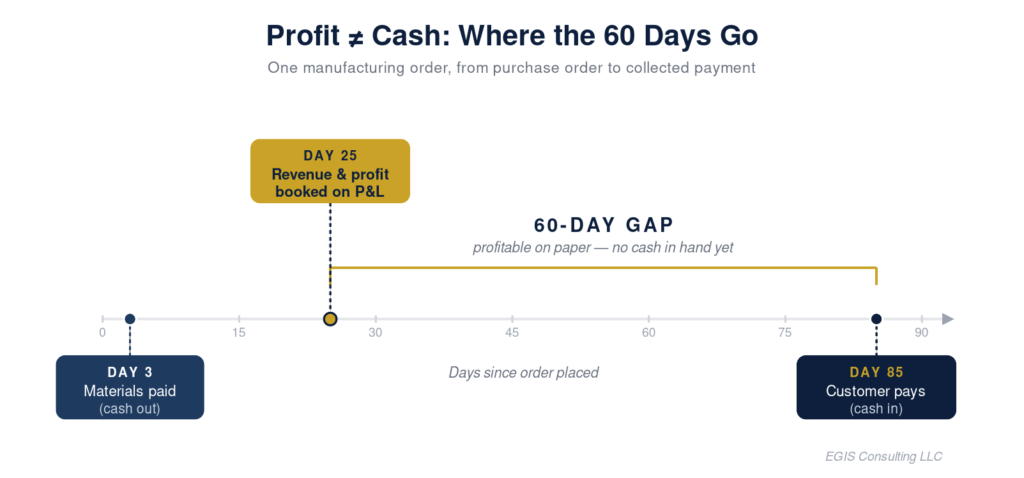
Take a manufacturer that lands a solid order. Here’s roughly how the timeline plays out:
- Day 3 — Raw materials are purchased to fulfill the order. Cash goes out the door.
- Day 25 — The order is produced and shipped. Under standard accrual accounting, this is when revenue — and the profit on that sale — gets recognized on the P&L.
- Day 85 — The customer, on standard 60-day payment terms, finally pays the invoice. This is the first moment any cash from that sale actually lands in the bank.
By day 25, the P&L already looks great. But the company won’t see a dollar of that sale in cash for another 60 days — and in the meantime, payroll, rent, and vendor payments don’t wait for the customer’s invoice to come due. That gap is where cash pressure comes from, even in a genuinely profitable business.
Why this catches growing companies off guard
Early on, when order volume is small and terms are simple, the gap between “profitable” and “cash in hand” is small enough not to notice. As a business grows — larger orders, more inventory carried, longer customer payment terms negotiated to win bigger accounts — that gap widens. A company can be growing and profitable and still find itself scrambling for a line of credit, not because anything is wrong, but because nobody built a model for how much cash the growth itself would temporarily absorb.
This is exactly the blind spot a 13-week rolling cash flow model is built to close. Unlike a P&L, which reports what already happened, a 13-week model looks forward — projecting actual cash in and cash out, week by week, based on real payment terms, real payroll dates, and real vendor obligations. It answers a much more immediate question than the P&L ever will: not “was this profitable,” but “will there be enough cash in the account on the Friday payroll runs six weeks from now.”
What to do with this
You don’t need a 13-week model to start closing this gap. A few starting questions worth sitting with:
- How many days, on average, pass between when you pay for materials or labor and when you collect payment from the customer? That’s your cash conversion cycle, and it’s the actual size of the gap you’re financing out of pocket or a credit line.
- Are your customer payment terms and your vendor payment terms working against each other — paying vendors in 15–30 days while collecting from customers in 60–90?
- Would you have visibility, today, into whether payroll six weeks out is fully covered — or would you find out the week it’s due?
None of this means the business is being run poorly. It means profit and cash are different measurements, and most owners were never handed a tool that tracks the second one. If you’ve ever looked at a strong P&L and still felt a knot in your stomach about the bank balance, that gap is almost certainly why — and it’s worth understanding the shape of it in your own numbers, whether that’s something you map out internally or bring in a second set of eyes to build out.
Robert Idzi, CMA, CSCA