
Lately, I’ve been getting the same question from business owners and leadership teams:
“What accounting system should we upgrade to—NetSuite, Great Plains, or something similar?”
It’s a reasonable question—but it’s often the wrong one.
The underlying assumption is that as a company grows, it must naturally “graduate” to a more sophisticated and expensive system. In reality, that mindset leads many organizations into costly implementations that fail to deliver meaningful improvements.
A better question is this:
Will a new accounting system actually improve how the business operates?
What I’ve Seen in Practice
Over the past several years, I’ve worked with companies on both ends of the spectrum.
I’ve seen organizations with over $200 million in revenue operating efficiently on QuickBooks Enterprise with minimal friction. At the same time, I’ve been brought into situations where companies invested hundreds of thousands of dollars implementing Oracle NetSuite—only to spend a year reworking processes and still struggle to produce reliable financials.
In many of those cases, I wasn’t involved at the beginning. I was called in afterward, when expectations didn’t match reality.
And more often than not, the issue wasn’t the system—it was the thought process behind the decision.
The Misconception About “Better” Systems
There’s a common belief that more advanced systems inherently provide better information.
They don’t.
At their core, accounting systems are databases. They store, organize, and report on data. More sophisticated platforms offer more ways to structure and analyze that data—but they don’t create it.
If the underlying data isn’t accurate, complete, and well-structured, a larger system simply produces more complex versions of the same problems.
In fact, in some cases, it makes them harder to identify.

Where Companies Should Start Instead
Before considering a system upgrade, companies need to step back and evaluate what’s actually missing.
If leadership feels like they lack visibility into the business, the first question shouldn’t be, “What system do we need?” It should be, “Why can’t we get this information today?”
Sometimes the limitation is real. But just as often, it comes down to process, configuration, or underutilization of the current system.
Modern accounting platforms—large and small—have evolved significantly. Integrations, reporting tools, and data connections have improved to the point where many perceived limitations can be addressed without a full replacement.
The Role of the Accounting Team
Another factor that’s frequently underestimated is staffing.
More advanced systems require more detailed data. More detailed data requires more structure, more oversight, and often more people.
There’s a disconnect I see regularly: companies want deeper insights while simultaneously trying to keep their accounting team lean. Those two objectives don’t always align.
A system doesn’t reduce the need for discipline—it increases it.
Without the right processes and personnel in place, a more complex system can actually slow things down, introduce inconsistencies, and reduce confidence in the numbers.
The ERP Expectation Gap
Many companies exploring upgrades are really looking beyond accounting—they’re considering full ERP solutions.
That introduces another layer of complexity.
There’s often an expectation—usually reinforced during the sales process—that a single system will handle everything seamlessly. In practice, that rarely happens.
Even the most robust platforms require:
- Additional systems
- Custom workflows
- Workarounds for edge cases
This becomes especially pronounced in manufacturing environments, where operational variability is the norm. Differences in production processes, inventory tracking, and quality control requirements mean that “out-of-the-box” solutions almost never fit perfectly.
And every customization introduces cost, time, and risk.
Integration Is Changing the Equation
One of the biggest shifts in recent years has been the expansion of system integrations.
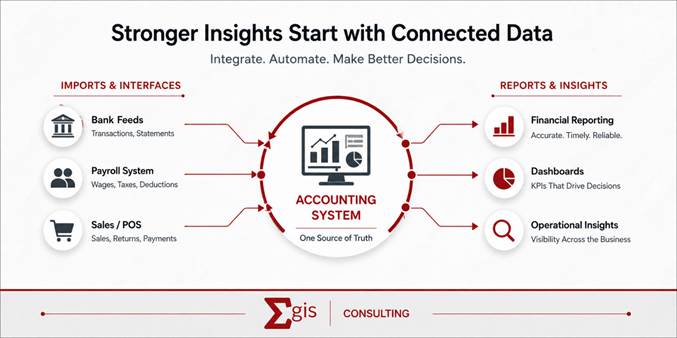
Today, accounting systems can connect directly to payroll providers, banks, payment processors, and operational platforms. Data that once required hours of manual entry can now be imported or automated in minutes.
I recently worked with a company that reduced a multi-hour payroll entry process into a five-minute import—with greater accuracy and detail.
Capabilities like this are no longer limited to high-end systems. They’re widely available and often underutilized.
Which raises an important point:
sometimes the better investment isn’t a new system—it’s using the current one more effectively.
The Cost Side That Gets Overlooked
When companies evaluate new systems, they tend to focus on licensing costs.
That’s only part of the equation.
The real investment includes implementation, training, internal resource allocation, process redesign, and the inevitable productivity dip during transition. There’s also the challenge of maintaining historical continuity and ensuring that reporting remains reliable throughout the change.
These factors add up quickly—and they’re often underestimated.
Accounting, by nature, is a cost center. Any investment needs to be weighed carefully against the operational benefit it provides.
A More Effective Approach
Upgrading an accounting system can absolutely be the right decision. In some cases, it’s necessary.
But it should be driven by clearly defined needs—not by the assumption that growth alone demands it.
In my experience, companies see the best results when they:
- Clearly identify the information gaps they need to solve
- Evaluate whether those gaps are system-related or process-related
- Fully understand the capabilities of their current platform
- Align staffing and processes with the level of data they want to capture
Only then does it make sense to evaluate whether a new system is truly the right solution.
Final Thought
A new system won’t fix unclear processes, inconsistent data, or misaligned expectations.
But the right system—implemented for the right reasons—can absolutely support growth and improve visibility.
The key is making sure the decision is grounded in operational reality, not assumption.